
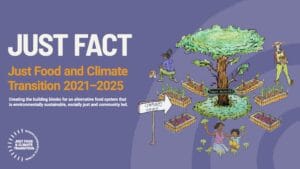
Over the last five years, communities in Tower Hamlets, London have come together through the Just Food and Climate Transition (Just FACT) programme, to build an alternative food system that is environmentally sustainable, socially just and community led. Projects have made space for collective learning and action; building on the wisdom and skills that exist in the borough’s gardens, community centres and kitchens. Some have built models that reimagine how food could be produced and sold, and how waste could be managed locally.
The project has now officially ended and we are proud to share the end-of-project report. This celebrates the 26 partners, 4,500 volunteers and 21,000 community members who took part in the programme. It reflects on what was built, what was learned, and what it takes to support community-led food system change over time.
Why a just food transition?
Food is at the heart of our lives. It’s how we nourish ourselves and our families, connect with our communities, and express our cultures.
Yet the current food system:
- contributes around 20% of global carbon emissions
- drives biodiversity loss
- leaves too many people struggling to afford healthy, nutritious food
In Tower Hamlets, these pressures are felt particularly strongly. Many residents rely on a supermarket system that benefits corporations, and there is a reliance on food banks. Climate change is already affecting people’s day to day lives, disrupting food supply chains and pushing prices higher, making existing inequalities worse. A just food transition means transforming the food system in a way that tackles climate change and inequality at the same time. Just FACT set out to show what this looks like in practice.
What projects achieved through Just FACT
1. Increased access to healthy sustainably produced, culturally appropriate, affordable food
Through establishing a network of Food Coops, piloting the impact of reducing financial barriers to organic produce, and setting up projects that grow culturally-appropriate foods that are staples to Tower Hamlets communities (such as kodu bottle gourds, amaranth and mooli).
2. Widened and deepened community participation
This has been done through listening to communities, meeting people where they already go, building trust and relationships, making activities practical and relevant, and ensuring inclusion across different groups. 26 grassroots organisations reached more than 20,000 people.
3. New knowledge, skills and employability
The programme built individual capability through knowledge and skill-sharing workshops (1,292 in total), practical training, and formal accreditation. For several residents their volunteer energy was transformed into paid roles.
4. A stronger local movement
This has been achieved by focussing on deep network building at the quarterly partner meetings, empowering local leadership, actively resourcing grassroots action, and supporting collaboration across groups. 60 groups and individuals were part of the Just FACT network, and a further 280 members of Tower Hamlets Food Partnership.
5.Trialled ways to reduce climate impacts of the food system
Reducing carbon emissions from food was trialled through reducing the use of plastic bags, local food production , composting and avoiding food waste (e.g. food re-distribution). The biggest reductions in emissions came from the Plastic Free Markets project, where 364,000 fewer plastic bags were used per year.
6. More power and decision-making in the hands of the local community
The programme enabled local groups and individuals to step into leadership roles, co-design projects, and establish self-governing structures. Through the participatory grants programme, community representatives were able to decide where funding should go.
7. Wellbeing, happiness, health, reduced isolation
Wellbeing and community cohesion benefits were valued as a vital part of building a food system that works for people as well as the planet. 13 projects reported wellbeing outcomes, sharing quotes and stories.
8. Influencing wider change
The learning is already shaping change locally. Tower Hamlets Council’s five-year Transforming Food Systems strategy was developed in response to Just FACT and will continue to be shaped with community input.
What the report offers
The Just FACT impact report brings together:
- learning about what supports genuine community-led change
- real examples of alternative food models
- reflections on power, participation and justice
- clear calls to action for funders, policymakers, housing associations and developers
“I hope that colleagues in government, the Greater London Authority, and locally in Tower Hamlets can get behind the learning and recommendations in this report and the communities who are paving the way for a fairer, sustainable food system.” – Apsana Begum, MP for Limehouse and Poplar
Why read the report?
If you are working on food justice, climate action, community organising or local policy, or if you want to understand what community-led climate action looks like on the ground, this report is for you. Above all, we hope it inspires others across the UK to build community-led food systems that work for people and the planet, and conveys the incredible life force, creativity and strength of the people of Tower Hamlets.
Join the webinar: A just, sustainable and community-led food system: Learning from Tower Hamlets
Thu 26 Feb 2026 2:00 PM – 3:15 PM GMT
Join the webinar to hear directly from projects who will tell the story of how farms, community food hubs and neighbourhood cooperatives have worked together and helped change how food is grown, supplied and sold in Tower Hamlets. Get your tickets here.